
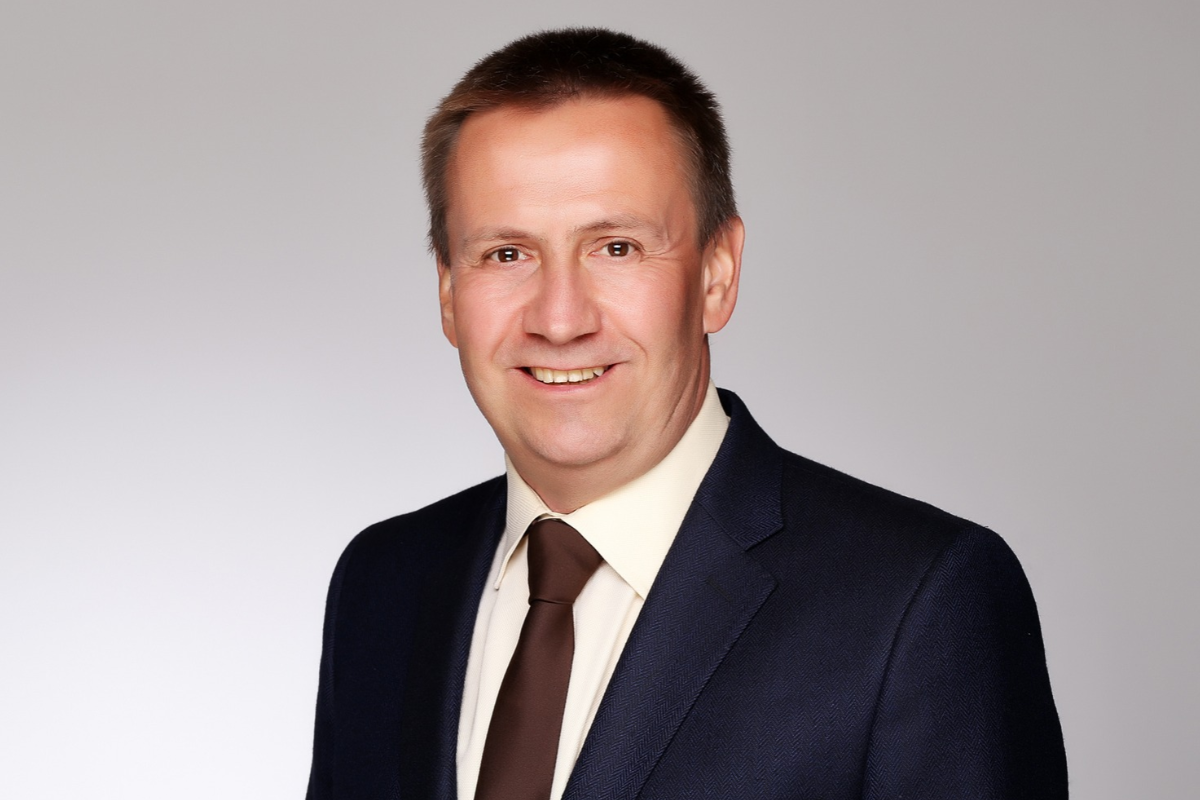
One leader. One perspective. One idea for tomorrow.
Engineer, serial entrepreneur and business mentor, Alain Sigrist brings to the economy a perspective shaped by scientific training and hands-on experience. For him, leadership rests on visionary intuition and emotional intelligence. Six questions for a professional who turns competition into a reason to cooperate.
You have led and supported companies in very different sectors. In light of your experience, what do you expect from a manager today that you did not expect ten years ago?
At the highest level of a company, it is essential to understand what a decision actually entails in practice. I expect a manager to show emotional intelligence and strong interpersonal skills. Knowing how to listen, welcoming reluctance without treating it as hostility, and looking for solutions beyond the emotional charge are fundamental skills. A manager is an agent of the future. Their vision should not boil down to a few principles set in stone: it must evolve, be understood and be shared. A company’s strength lies in its leaders’ ability to harness the creative power of the women and men who make it up.
In your view, which skill will matter most for leading over the next five years?
Anticipation. The fundamentals of running a business have not changed, but the timeframe in which they operate has changed profoundly. Technologies transform how people use things, those new uses change customer expectations, and these new expectations in turn redefine markets. Leaders must therefore be able to keep their company evolving at all times, without giving up the know-how that makes up its value. It is a delicate exercise: you have to prepare skills, steer investments and launch transformations early enough not to be overtaken by them. This means accepting that you can no longer live on past achievements for long. Constant observation of the market, as well as continuing education, have become matters of survival.
You argue that a company can find more of a future by creating new market spaces than by always confronting the same competitors. But how can a leader detect the need to question the model that made it successful?
By the time sales start to decline or a competitor introduces a major innovation, it is often already too late. You need to listen to the market continuously, well beyond traditional satisfaction surveys. How do customers really use our products? What solutions are they looking for elsewhere? What prevents them from being fully satisfied? It is just as worthwhile to ask those who are not our customers, because they can reveal needs that no one is yet meeting. My engineering background and my experience in scientific research have shaped my personal approach: in research, you observe, you measure, you formulate hypotheses, and you question your own methods when the results demand it. Why not apply the same approach to business?
For a long time, we have regarded growth as the proof of a company’s success. Can we now imagine other forms of development, just as ambitious but more sustainable?
SMEs need to grow in order to reach financial stability. But once that stability has been achieved, growth is no longer necessarily an end in itself. A company can keep a relatively stable size while innovating, renewing its skills and staying fully in tune with its market. It can also decide to diversify its activities, not to become bigger, but to reduce its dependence on a single market and secure its future. The real question, then, is not necessarily one of growth, but of adaptability. A company may not grow and yet develop considerably in the way it thinks, innovates and responds to the expectations of its customers, and above all of its employees.
If artificial intelligence becomes capable of taking on a growing share of strategic analysis, design and decision-making, what will be the decisive role of leaders?
I would rather speak of artificial investigation than artificial intelligence. We have an extraordinary tool, capable of analysing vast amounts of statistical data in moments and bringing out avenues we would not necessarily have thought of. But it remains a tool. “Ex nihilo nihil fit”: innovation often springs from analogy, from the ability to transpose an idea from one world to another, to bring together seemingly unrelated issues, or to adapt a context-specific proposal to a different reality. AI can speed up this thinking, stimulate it, even shake it up. But the danger would be to confuse “access to the answer” with deep knowledge. I could not commit a company’s future on the sole basis of an analysis produced by artificial intelligence.
ONE IDEA TO TAKE AWAY
If our readers were to take away just one idea from your experience as a business leader to become better leaders, what would it be?
Never stop observing the world in which your company operates. Measure it, seek to understand how it works, and develop your own vision. Know how to share that vision. Employees, like customers, need to understand why you do what you do. It is in this “why”, even before the “how” and the “what”, that their commitment is built.


